3625. Count Number of Trapezoids II
Hard40.1% acceptance57,370 / 143,237 submissions
Asked by 2 companies
Topics
You are given a 2D integer array points where points[i] = [xi, yi] represents the coordinates of the ith point on the Cartesian plane.
Return the number of unique trapezoids that can be formed by choosing any four distinct points from points.
A trapezoid is a convex quadrilateral with at least one pair of parallel sides. Two lines are parallel if and only if they have the same slope.
Example 1:
Input: points = [[-3,2],[3,0],[2,3],[3,2],[2,-3]]
Output: 2
Explanation:
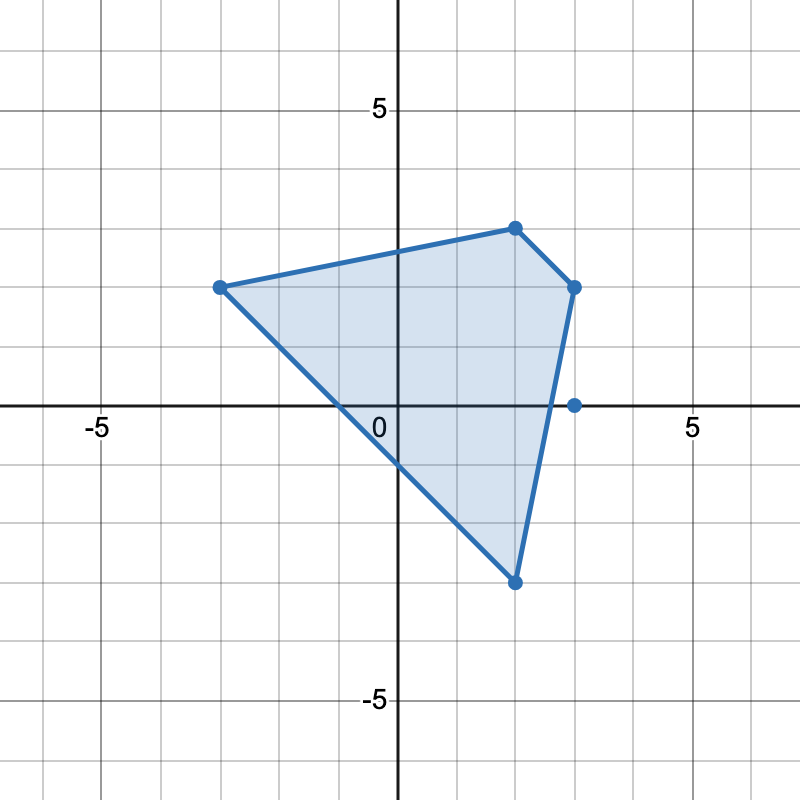
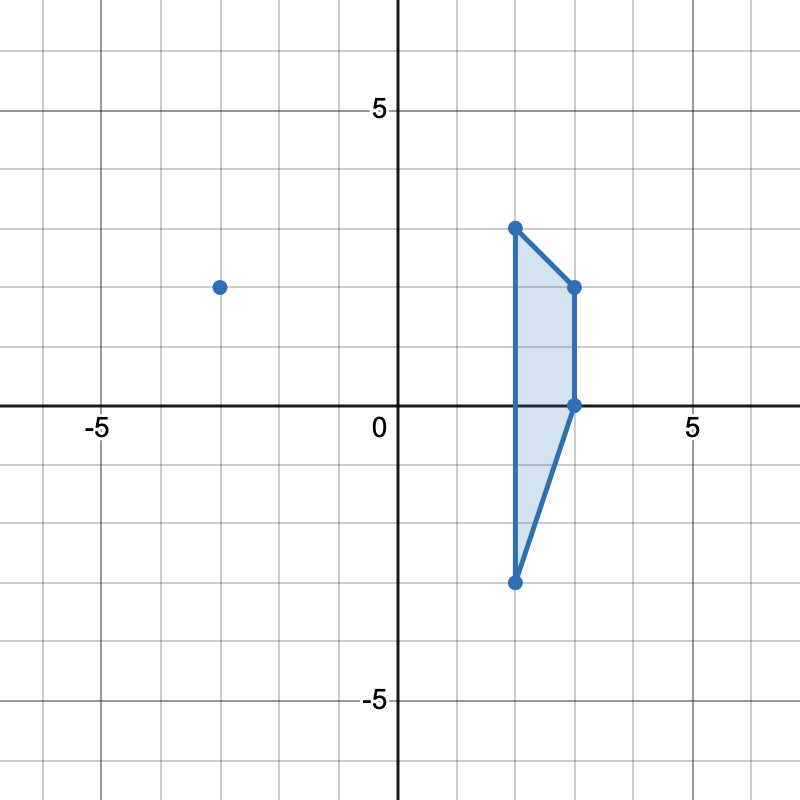
There are two distinct ways to pick four points that form a trapezoid:
- The points
[-3,2], [2,3], [3,2], [2,-3]form one trapezoid. - The points
[2,3], [3,2], [3,0], [2,-3]form another trapezoid.
Example 2:
Input: points = [[0,0],[1,0],[0,1],[2,1]]
Output: 1
Explanation:
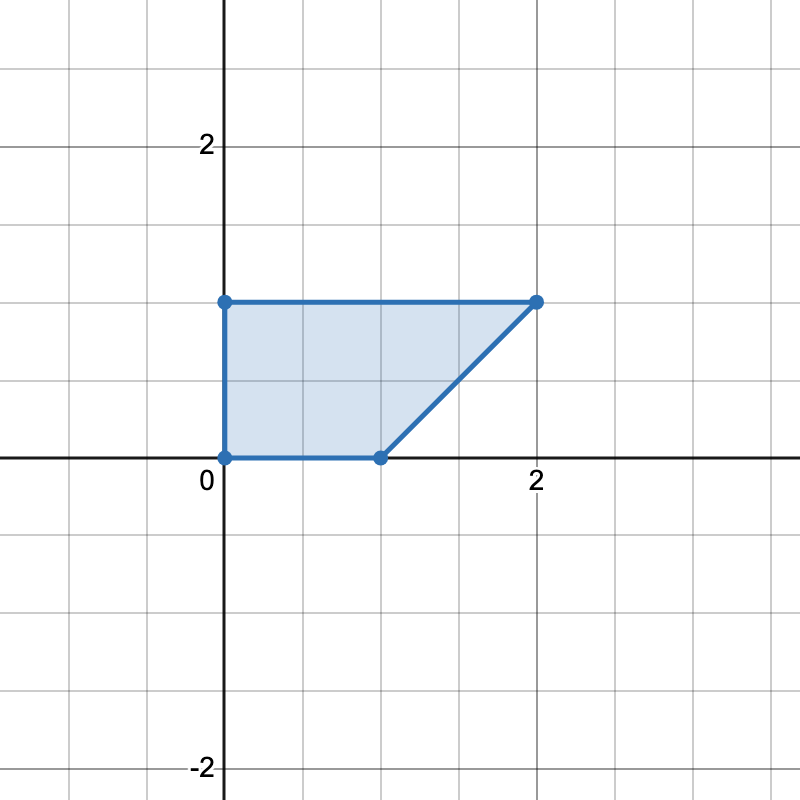
There is only one trapezoid which can be formed.
Constraints:
4 <= points.length <= 500–1000 <= xi, yi <= 1000- All points are pairwise distinct.
Hints
Hint 1
Hash every point-pair by its reduced slope
(dy,dx) (normalize with GCD and fix signs).Hint 2
In each slope-bucket of size
k, there are C(k,2) ways to pick two segments as the trapezoid's parallel bases.Hint 3
Skip any base-pair that shares an endpoint since it would not form a quadrilateral.
Hint 4
Subtract one count for each parallelogram. Each parallelogram was counted once for each of its two parallel-side pairs, so after subtracting once, every quadrilateral with at least one pair of parallel sides, including parallelograms, contributes exactly one to the final total.
Hint 5
Final answer = total valid base-pairs minus parallelogram overcounts.