2791. Count Paths That Can Form a Palindrome in a Tree
Hard48.4% acceptance10,694 / 22,078 submissions
Asked by 4 companies
Topics
You are given a tree (i.e. a connected, undirected graph that has no cycles) rooted at node 0 consisting of n nodes numbered from 0 to n - 1. The tree is represented by a 0-indexed array parent of size n, where parent[i] is the parent of node i. Since node 0 is the root, parent[0] == -1.
You are also given a string s of length n, where s[i] is the character assigned to the edge between i and parent[i]. s[0] can be ignored.
Return the number of pairs of nodes (u, v) such that u < v and the characters assigned to edges on the path from u to v can be rearranged to form a palindrome.
A string is a palindrome when it reads the same backwards as forwards.
Example 1:
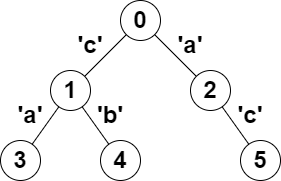
Input: parent = [-1,0,0,1,1,2], s = "acaabc"
Output: 8
Explanation: The valid pairs are:
- All the pairs (0,1), (0,2), (1,3), (1,4) and (2,5) result in one character which is always a palindrome.
- The pair (2,3) result in the string "aca" which is a palindrome.
- The pair (1,5) result in the string "cac" which is a palindrome.
- The pair (3,5) result in the string "acac" which can be rearranged into the palindrome "acca".
Example 2:
Input: parent = [-1,0,0,0,0], s = "aaaaa"
Output: 10
Explanation: Any pair of nodes (u,v) where u < v is valid.
Constraints:
n == parent.length == s.length1 <= n <= 1050 <= parent[i] <= n - 1for alli >= 1parent[0] == -1parentrepresents a valid tree.sconsists of only lowercase English letters.
Hints
Hint 1
A string is a palindrome if the number of characters with an odd frequency is either 0 or 1.
Hint 2
Let mask[v] be a mask of 26 bits that represent the parity of each character in the alphabet on the path from node 0 to v. How can you use this array to solve the problem?