1819. Number of Different Subsequences GCDs
Hard45.0% acceptance12,891 / 28,620 submissions
Asked by 2 companies
Topics
You are given an array nums that consists of positive integers.
The GCD of a sequence of numbers is defined as the greatest integer that divides all the numbers in the sequence evenly.
- For example, the GCD of the sequence
[4,6,16]is2.
A subsequence of an array is a sequence that can be formed by removing some elements (possibly none) of the array.
- For example,
[2,5,10]is a subsequence of[1,2,1,2,4,1,5,10].
Return the number of different GCDs among all non-empty subsequences of nums.
Example 1:
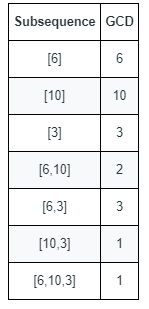
Input: nums = [6,10,3]
Output: 5
Explanation: The figure shows all the non-empty subsequences and their GCDs.
The different GCDs are 6, 10, 3, 2, and 1.
Example 2:
Input: nums = [5,15,40,5,6]
Output: 7
Constraints:
1 <= nums.length <= 1051 <= nums[i] <= 2 * 105
Hints
Hint 1
Think of how to check if a number x is a gcd of a subsequence.
Hint 2
If there is such subsequence, then all of it will be divisible by x. Moreover, if you divide each number in the subsequence by x , then the gcd of the resulting numbers will be 1.
Hint 3
Adding a number to a subsequence cannot increase its gcd. So, if there is a valid subsequence for x , then the subsequence that contains all multiples of x is a valid one too.
Hint 4
Iterate on all possiblex from 1 to 10^5, and check if there is a valid subsequence for x.